
Inner Cycles
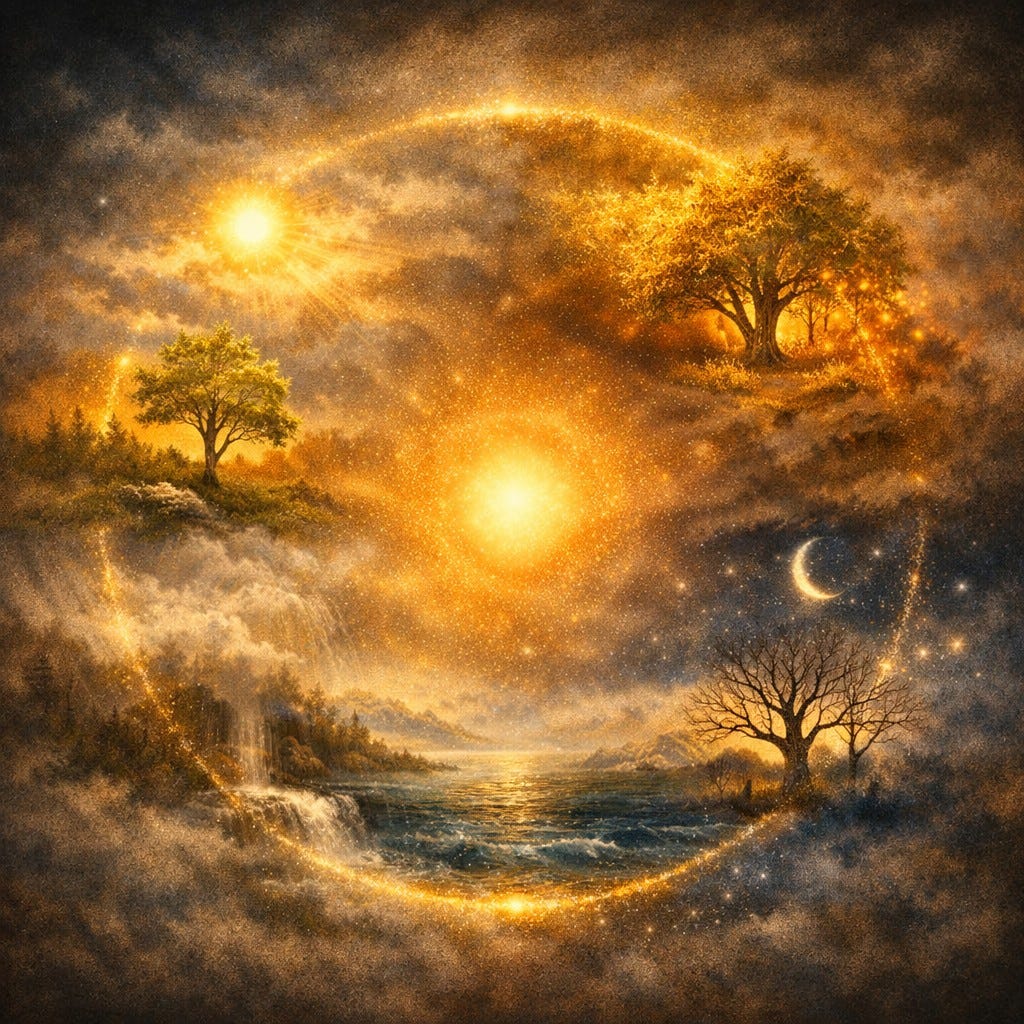
The inner world moves in rhythms. Some shifts arrive like weather, changing the atmosphere of the moment. Others unfold like seasons, shaping the deeper currents of our becoming. And some move with the quiet precision of the sky, rising and falling like day and night, waxing and waning like the Moon, or turning through rare thresholds like eclipses.
Inner Cycles brings these movements together, offering a way to recognise the climates that pass through us, the longer arcs that guide us, and the celestial rhythms that shape the inner sky.
Inner Emotional Weather speaks to what we feel now.
Inner Seasonal Changes reveals the slow turning of the inner world through descent, renewal, fullness, and release.
Inner Celestial Rhythms illuminates the daily, monthly, and rare initiatory movements that unfold in their own natural way.
Inner Life Cycles finally reveal the long arc beneath all these movements, the quiet journey a soul takes from arrival to return.
Each movement also carries its own subtle distortions, the small ways the inner world hesitates or stalls at different times or stages, reminding us that no one moves through these cycles without resistance.
1. Inner Emotional Weather
Feelings move through us like inner weather. Each one carries a message from the deeper self. When we meet an emotion from its calm centre, we can sense the whole of it rather than being pulled into its extremes, allowing it to flow through, reveal its quiet wisdom, and drift onwards.
Inner Emotional Weather offers a way to meet each emotion with presence rather than resistance. These short reflections are not instructions but invitations, a gentle path through the shifting weather of the heart.
This map turns toward:
I. The Primary Weather Patterns that form the natural movements of the inner world.
II. The Transitional Weather shifts that appear between them as the sky changes.
III. The Distorted Weather Patterns that arise when the natural weather cannot move.
IV. The Stalled Weather states that emerge when the inner sky goes quiet and movement pauses.
I. Primary Weather Patterns:
These are the core movements of the inner world, the primary weather patterns that rise from the deeper ground of the self.
Joy
Joy rises like a bright flame in the inner world. It reminds us of our natural capacity for the heart to open in small and unexpected moments. When we let it move through without grasping for it, joy becomes a gentle companion rather than something to chase.
Sadness
Sadness moves like a deep current beneath the surface of the self. It carries the echoes of what mattered and what was lost. When we let it flow through without fear, sadness helps us hear what the heart has been holding, and opens a quiet space where we can breathe again.
Anger
Anger rises like a sudden flame that protects what is sacred within us. It shows us where a boundary has been crossed or a truth ignored. When its heat grows too strong to hold, it can spill outward as projection, simply because the feeling is carrying more than we can manage in the moment. When we meet it with steadiness, anger becomes a clear guide.
Fear
Fear rises from the depths like a cold wind when something in us feels at risk. It carries the instinct to protect what matters most. When we allow it to move through without letting it take the lead, fear reveals the tender places that need our care.
Shame
Shame settles over us like a heavy veil. It appears when something in us feels exposed or not enough. Sometimes it rises from our own inner expectations, and sometimes from the weight of what others hoped we would be. Shame urges us to withdraw and protect the most vulnerable aspects of our true self. When we listen gently, we can accept these parts and continue walking our own unique path.
Grief
Grief moves through the inner world like an ancient tide. It reshapes the landscape of the self, pulling us inward and asking us to feel what cannot be replaced. It softens the edges of what we thought we could hold. When we honour its presence, grief becomes an opening into a deeper understanding and connection to life.
Love
Love moves through the inner world like a steady glow. Its eternal warmth reaches the places that once felt distant or dim. When we let it in, love becomes a quiet presence that reminds us we are held. As it opens, love moves outward as compassion, the gentle willingness to remain present with another’s pain without turning away, arising naturally from inner coherence. When we rest in it, love becomes a calm space where the heart can open and deepen our connection to soul.
Trust
Trust moves through the inner world like a gentle settling. It loosens the grip of fear and invites a deeper breath. As it finds its place within us, trust becomes a quiet strength that steadies our way forward. Trust is a grounded knowing that allows us to move with life instead of resisting its flow.
Courage
Courage moves through the inner world like a small, steady flame. It does not chase away fear but warms the space around it. When we listen closely, courage becomes the gentle impulse that helps us take the next step even when the way ahead is unclear.
Confusion
Confusion moves through the inner world like a shifting mist. It obscures our sense of direction and loosens what we thought we knew. Yet in this quiet disorientation, we are invited to pause, to listen, to let the way reveal itself in its own time, opening slowly toward a path that feels both new and unfamiliar.
Loneliness
Loneliness opens within like a vast, echoing plain. It reveals the places where connection once lived and the tender ache of their absence. It stretches the inner world until we can hear the faintest movements of our own heart. In its wide silence, we begin to sense what truly matters and what has been waiting for us beneath the noise. It reveals the empty spaces we often avoid and the quiet truths we rarely meet.
Wonder
Wonder rises within like a calm widening of the inner sky. It opens the edges of our certainty and draws our attention to the small, luminous details we often pass by. In its presence, the world feels larger, more alive, touched by a quiet magic we cannot name. As it opens the inner sky, wonder reveals a brief glimmer of the awe that lives just beyond our reach.
These patterns form the foundation of the inner sky, the movements from which all other weather begins.
II. Transitional Weather
Some experiences often named as emotions are not primary weather patterns but movements between them, the small shifts in the inner sky that help the deeper weather turn.
Surprise
A sudden shift in orientation, the moment the inner world catches up to something unexpected.
Anticipation
A forward leaning movement where curiosity and fear stir together toward what has not yet arrived.
Relief
A soft release that appears when tension loosens and the inner world exhales.
Disappointment
A collapse of expectation that blends sadness and confusion as the sky lowers.
Regret
A backward turning movement where sadness and shame look toward what cannot be changed.
Anticipatory Grief
A forward moving grief that rises before the loss fully arrives, carrying both fear and tenderness.
Hope
A quiet clearing where fear softens and trust begins to return.
Awe
A threshold state where fear meets wonder and the inner sky widens beyond what the self can hold alone.
These movements are the small changes that occur between the primary emotional weather patterns so they can continue their inner path.
III. Distorted Weather Patterns
Some inner weather becomes distorted when movement is blocked, creating patterns that form around strain instead of the natural rhythm of the heart.
Panic
Panic appears when fear surges faster than the inner world can hold it, creating a sudden break in grounding where the body reacts before the mind can orient.
Terror
Terror rises when the sense of safety collapses entirely, leaving the psyche overwhelmed and unable to find any inner place of refuge.
Anxiety
Anxiety forms when fear cannot settle, looping through the mind in search of certainty the inner world does not yet feel.
Jealousy
Jealousy emerges when fear and attachment intertwine, creating a grasping response to the possibility of losing what feels essential.
Envy
Envy appears when longing turns outward, reaching for what another carries instead of recognising the deeper need within.
Greed
Greed is caused by a collapse of trust in the inner world, where desire can become distorted and reach outward in search of safety.
Hatred
Hatred forms when anger fuses with fear, creating a hardening of the heart that protects against vulnerability by pushing outward.
Depression
Depression arises when sadness, grief, or loneliness can no longer move, creating an inner stillness where the emotional world collapses inward.
Distorted Happiness
Happiness becomes distorted when joy is pursued as a constant, turning into a surface striving that tries to perfect or preserve what is meant to rise and fall without attachment.
Distortion appears when we grasp at the weather itself. Courage becomes control when it is forced. Love becomes conditioned when it is held too tightly. Positivity becomes a bypass, reaching for the lighter emotions when it is used to avoid what feels difficult in the inner climate. Hope becomes a reaching toward the future when it is grasped, pulling us away from the movement that is already unfolding now. Softening becomes postponing. Opening becomes circling.
Bliss and peace can also become distorted when they are pursued as permanent states. They are not emotions but brief movements of inner alignment and settling, moments that arise naturally when the psyche softens. When we try to hold them as constants, they harden into ideals that pull us away from the natural movements of the inner world.
Warm spirited emotions such as joy and wonder do not live this way. They rise and fall like weather, arriving as brief openings rather than conditions to maintain. When we release the pressure to hold any feeling in place, whether bliss, peace, courage, hope, or anything else, the inner climate can move freely again.
Distorted Weather Patterns form when the natural emotional weather cannot move as it needs to. They are the storms, fogs, freezes, and droughts that appear when the inner climate becomes imbalanced.
IV. Stalled Weather
These are the states where the inner sky goes quiet. They are not emotions but pauses in movement, moments when the deeper weather cannot yet turn. They show where the self has withdrawn from engagement or where meaning has not yet gathered enough weight to stir the inner world.
Apathy
Apathy is the sense of movement going quiet. It appears when nothing inside feels close enough to stir the inner world. It is not sadness or numbness but a stillness of meaning, a pause where the self withdraws its energy because nothing yet calls it forward. It shows where the inner sky has gone flat, waiting for something real enough to wake it.
Boredom
Boredom is the restlessness of unused energy. It rises when the inner world is ready to move but finds nothing with enough depth to meet it. It is not frustration or curiosity but a quiet itch at the edges, a sign that the self is holding more life than the moment can hold. It shows where the inner sky is stalled, waiting for something real enough to engage its attention.
Even the inner sky has its stillness. Stalled Weather marks the moments when movement pauses and meaning has not yet gathered its weight. They reveal where the self is waiting for something real enough to stir it, reminding us that even stillness has its truth.
Emotional weather moves through the inner world the way clouds move across a wide sky. Each feeling has its own texture, its own rhythm, its own quiet truth. None of them ask to be controlled. They ask to be met.
Let each emotion rise and fall in its own way. Listen for what it reveals rather than what it demands. In this gentle attention, the inner world begins to open, and the natural weather of the heart can move again.
2. Inner Seasonal Changes
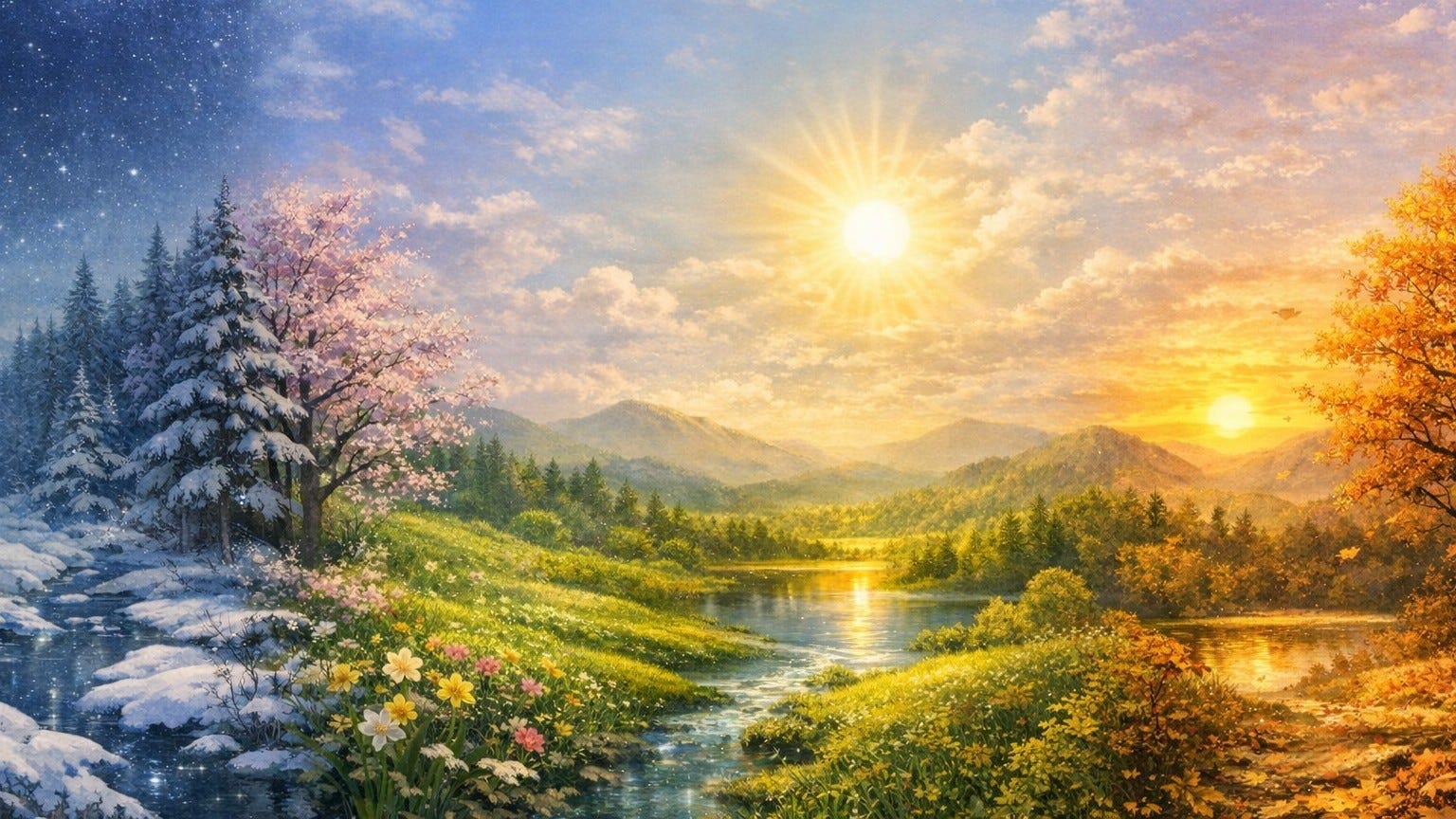
The inner world moves through cycles that unfold over a much greater span of time than the shifting patterns of emotional weather. These movements are the slow turning of the self through descent, renewal, fullness, and release.
While these inner seasons mirror the outer ones in spirit, they do not follow the calendar. They rise in response to the deeper movements of a life, shaped by obstacles, initiations, aging, and rites of passage that unfold in their own course of time. At times these seasons can hesitate or stall, creating subtle distortions in the turning.
Inner Seasonal Changes offers a way to listen to these natural rhythms and growth cycles, to recognise when something inside is withdrawing, emerging, expanding, or letting go. Each season carries its own message. Each solstice and equinox marks a threshold. Together they form a rhythm of becoming that moves through us again and again.
This is the point where the cycle begins to turn.
I. Inner Winter: The Descent
Inner Winter is the season of descent. It arrives when the inner world begins to withdraw from the surface and turn toward its own depths. The light grows thin. The pace and energy slows. What once felt clear becomes quiet and uncertain. This is not a collapse but a return, a movement toward the roots of the self.
In this inner season the emotional tones of grief, sadness, confusion, and loneliness often rise to the surface. They are not signs of failure. They are invitations to rest, to listen, to let the deeper layers speak in their own time. Winter asks for stillness. It asks for patience. It asks for trust in what cannot yet be seen.
The Winter Solstice marks the threshold of this season, the deepest point of descent. It is the moment when the inner world reaches its darkest place and begins its slow return toward the light again.
The descent is not the end. It is the beginning of the return.
II. Inner Spring: The Emergence
Inner Spring is the season of emergence. After the long descent of Winter, something inside begins to stir. The inner world softens. The first signs of movement appear. They are small at first, almost fragile, but they carry the quiet promise of renewal. Spring does not rush. It opens in its own way, guided by a rhythm that rises from within.
In this inner season the emotional tones of trust, courage, and wonder begin to return. They do not arrive all at once. They come as gentle signals that the inner world is ready to lift its gaze again. Spring invites the energy of curiosity. It invites a slow awakening. It invites the first steps toward what is beginning to grow.
The Spring Equinox marks the threshold of this season, the moment when light and dark come into balance. It is the turning point where the inner world begins to lean toward growth and possibility.
Emergence is not arrival. It is the first breath of possibility.
III. Inner Summer: The Fullness
Inner Summer is the season of fullness. After the slow emergence of Spring, the inner world opens into a wider field of light. Energy rises. Clarity strengthens. What once felt tentative begins to take form. This is the season when the self steps forward with greater confidence and allows its inner warmth to be seen.
In this inner season the emotional tones of joy and love come into their natural expression. They are not forced. They arise from a sense of connection with the world and with the deeper truth within. Summer invites presence. It invites expression. It invites the full experience of what has been growing quietly beneath the surface.
The Summer Solstice marks the threshold of this season, the moment when the inner world reaches the height of its light. It is the crest of the cycle, the place where clarity stands at its brightest before the turning begins.
Fullness is not forever. It is the crest before the turning.
IV. Inner Autumn: The Release
Inner Autumn is the season of release. After the fullness of Summer, the inner world begins to soften and turn inward once more. Energy settles. Clarity deepens. What has reached its peak starts to loosen its hold. This is not a loss but a natural easing, a gentle shift from expression toward reflection.
In this inner season the emotional tones of sadness, grief, and acceptance often rise with quiet honesty. They are not signs of decline. They are reminders that every cycle carries its own completion. Autumn invites reflection. It invites gratitude for what has grown. It invites the steady work of letting go so the inner world can return to its roots with greater clarity.
The Autumn Equinox marks the threshold of this season, the moment when light and dark come into balance once again. It is the turning point where the inner world begins its descent, carrying the wisdom of what has been gathered along the way.
Release is not loss. It is the preparation for descent.
Distortion in the Seasons
Distortion in the seasons appears when the inner world hesitates at its natural turning.
Avoidance may rise as a quiet postponing of descent.
Clinging may appear as holding on to a fullness that has already completed.
Numbing may soften what asks to be released.
These distortions do not stop the seasons forever.
They simply slow the turning until the inner world is ready to move again.
Inner Seasonal Changes reminds us that the self is always moving, always turning, always returning to its own depths and rising again. These seasons do not ask for control. They ask for presence. They ask for trust in the natural rhythm and flow that carries us through descent, renewal, fullness, and release. When we learn to recognise these movements, we begin to surrender to the cycle rather than resist it, and the inner world opens in its own time, revealing a deeper sense of clarity, resilience, and quiet wholeness.
3. Inner Celestial Rhythms
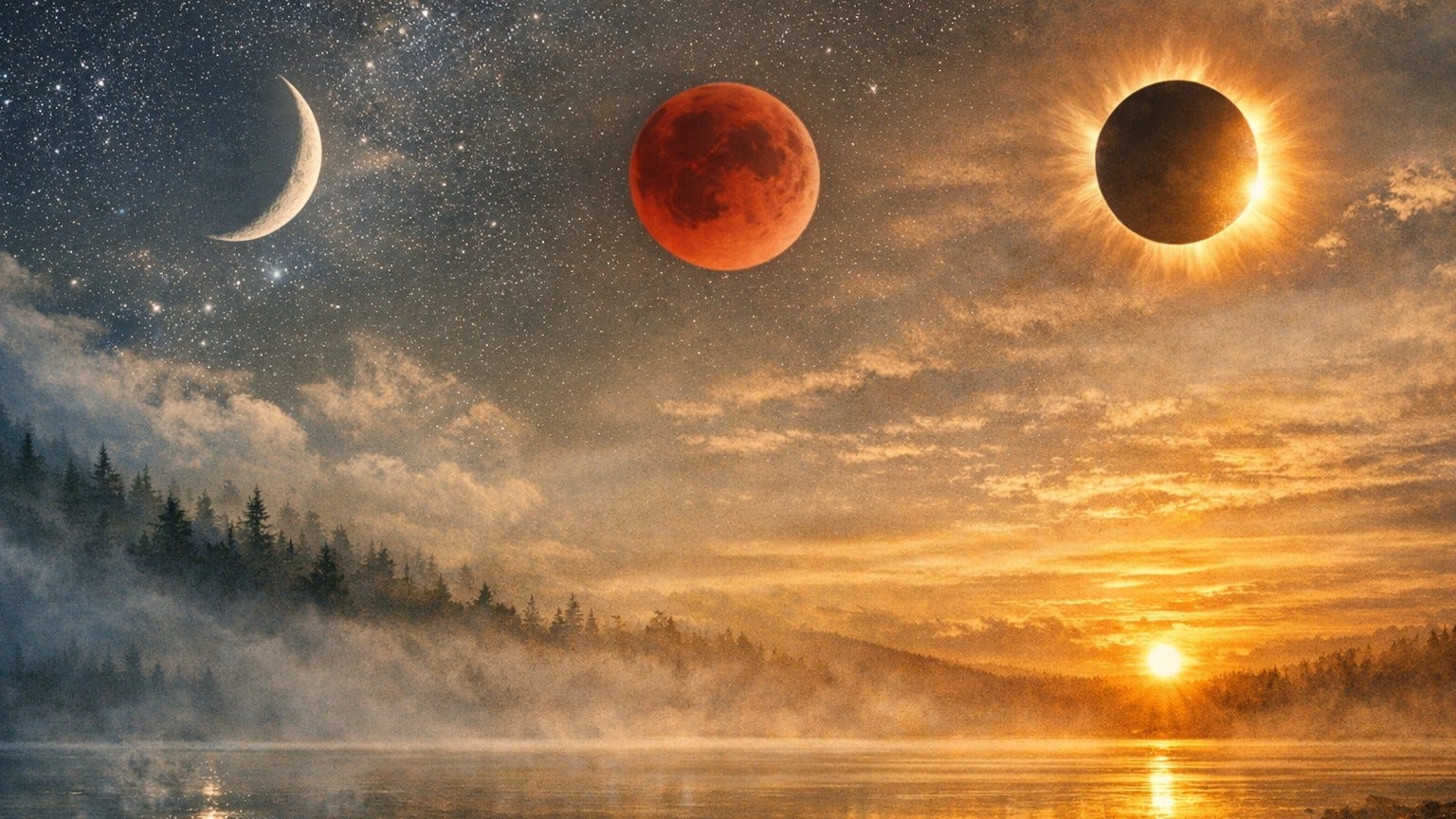
The inner world is shaped not only by weather and seasons but also by the quiet movements of the sky. These rhythms rise and fall within us just as they do above us, shifting the quality of our awareness and the depth of our inner tides. Day and Night reflect the movement between clarity and dream. The Moon reveals the waxing and waning of emotional life. The Sun carries the steady arc of identity and direction. And Eclipses mark rare thresholds when shadow and revelation meet.
These Inner Celestial Rhythms often echo the movements of the outer sky, yet they do not mirror them exactly. Night may bring a natural quietening. A full Moon may stir emotional charge. But the psyche follows these patterns in its own way. Inner Celestial Rhythms offers a way to listen to these symbolic movements as they unfold within the self, the subtle cycles that guide our inner light and shadow and shape the inner sky. At times these rhythms can tighten or repeat, creating small distortions in their natural flow at different stages of the inner journey.
I. Day and Night
Day and night move through the inner world just as they move through the outer one. They shape the rhythm between clarity and dream, outward focus and inward descent. These shifts often echo the sky above, yet they unfold within us in their own way.
Day carries the qualities of movement, direction, and conscious engagement. It is the part of the inner world that reaches outward, makes choices, and steps into the visible path.
Night draws us inward. It softens the edges of thought, opens the imaginal, and invites reflection. It is the quietening that allows what has been overlooked to rise.
Together, day and night form the natural breath of the psyche, a cycle of illumination and rest, expression and renewal, each one preparing the way for the other.
II. Moon Phases
The Moon moves through phases that echo the tides of the emotional world. These shifts often reflect the sky above, yet they unfold within us in their own way and in their own time. Each phase carries a different quality of feeling, a different movement of the inner tide.
The Waxing Moon carries a sense of building. Something begins to gather strength, a quiet momentum that draws us forward.
The Full Moon heightens what we feel. Emotions rise to the surface, clarity sharpens, and what has been waiting often becomes visible.
The Waning Moon brings release. The emotional tide softens, and the inner world begins to let go of what has reached its peak.
The Dark Moon invites stillness. It is the quiet space before renewal, a moment of rest and mystery where new beginnings take shape in the unseen.
These phases offer a symbolic map for understanding the natural rise and fall of emotional life, a reminder that every feeling has its own rhythm and its own return.
III. The Suns Arc
The Sun moves with a steady rhythm that reflects the long arc of identity and direction. Its path across the sky offers a symbolic way to understand the movement of the conscious self, the part of us that seeks clarity, purpose, and a sense of forward motion.
The Rising Sun carries the feeling of beginnings. It brings warmth, vitality, and the first spark of intention. It is the moment when something inside us steps into view.
The Midday Sun reflects fullness and presence. It is the height of clarity, the place where we feel most aligned with our direction and most connected to our sense of self.
The Setting Sun invites completion. It softens the pace, closes chapters, and prepares the inner world for rest and renewal. It is the gentle descent that makes space for reflection.
Across seasons, the Sun also shifts in strength and tone. This long movement mirrors the slow changes within us, the gradual shaping of identity that unfolds over time.
The Suns arc reminds us that growth is not sudden. It is a steady movement of light that rises, peaks, and returns, again and again.
IV. Eclipses
Eclipses are rare moments when the familiar rhythm of the sky shifts. They echo the inner thresholds we meet when shadow and light cross paths within us. These moments do not arrive often, yet when they do, they carry a sense of significance that is felt more than understood.
A Solar Eclipse occurs when the Moon moves across the face of the Sun. In the inner world, this reflects the moment when the emotional or unseen self interrupts the conscious path. Something rises from within and asks to be acknowledged, even if it changes the direction we thought we were taking.
A Lunar Eclipse occurs when the Earth casts its shadow across the Moon. In the inner world, this mirrors the moment when emotional truth is touched by shadow. Feelings that were clear may become veiled, or something long hidden may begin to reveal itself.
Eclipses mark turning points. They signal the arrival of an inner shift that cannot be ignored. They remind us that shadow is not an interruption of the journey, but a part of its natural unfolding.
Distortion in the Rhythms
Distortion in the rhythms appears when repeating movements lose their natural completion.
Looping may take the place of progress, a rhythm that circles without carrying us forward.
Compulsion may tighten the daily or monthly patterns into repetition.
Obsession may narrow the inner world around one point, preventing the rhythm from completing its arc.
These distortions ease the moment the rhythm is allowed to finish what it began.
Inner Celestial Rhythms invite us to notice the quiet movements that shape the inner sky. These rhythms echo the world above, yet they unfold in ways that are entirely our own. Day and night, the phases of the Moon, the arc of the Sun, and the rare crossings of shadow and light all offer symbolic ways to understand what is shifting within.
When we listen to these movements, we begin to sense the subtle tides that guide us. We recognise when something is rising, when something is softening, and when a deeper truth is waiting to be seen.
The inner sky is always moving. Its rhythms offer a way to return to the deeper currents that shape our path from within.
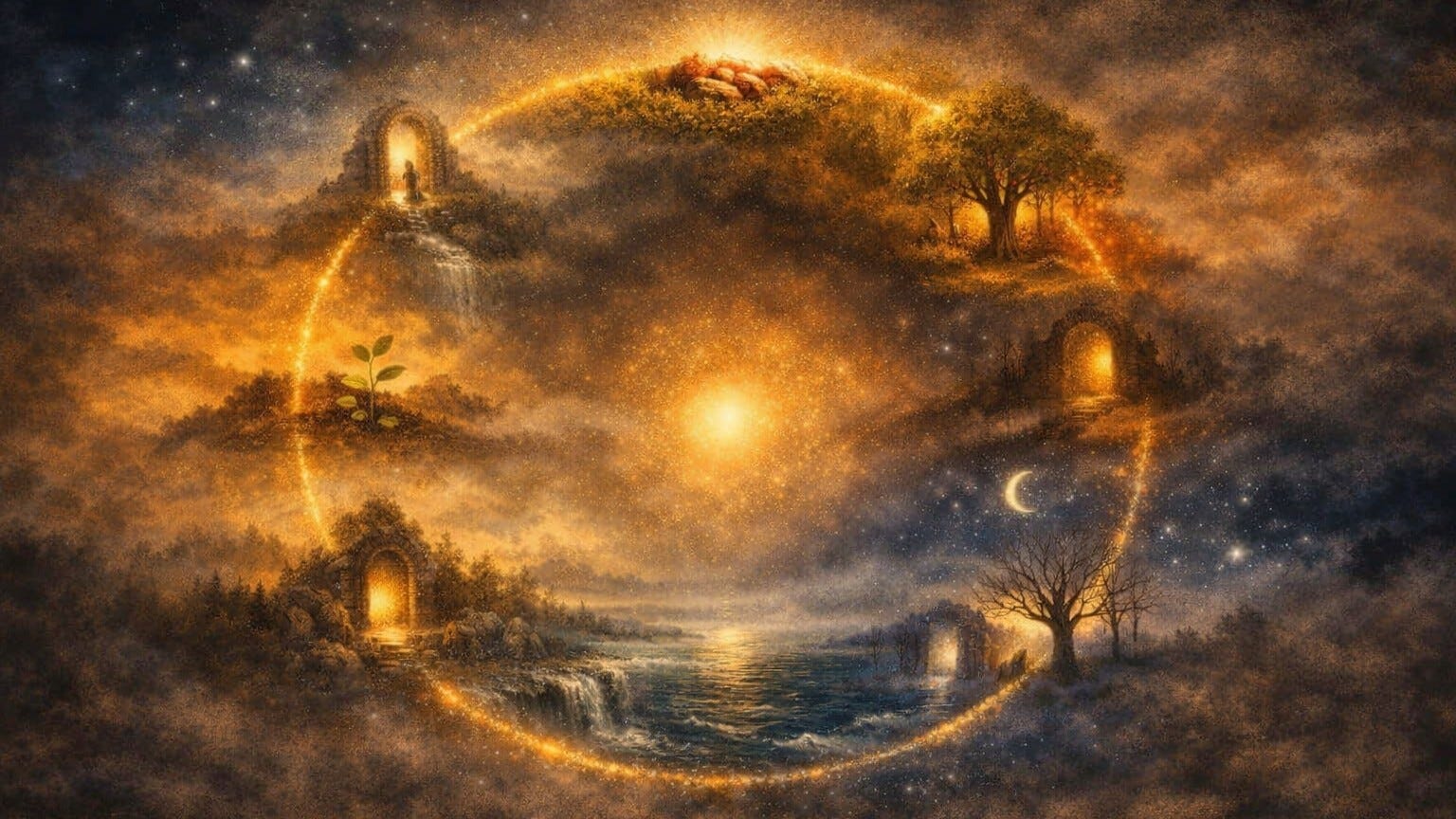
4. Inner Life Cycles
All the movements within the inner world rise and fall inside a larger rhythm. The shifting weather of emotion, the slow turning of the inner seasons, and the quiet dance of light and shadow all belong to a deeper pattern that carries us from arrival to return.
These smaller cycles show us how the psyche moves. The inner life cycles reveal what the psyche is moving through.
Inner Life Cycles trace the long arc of a life in ten stages, from the first spark of becoming to the final threshold of dissolution. They hold the moments of awakening and separation, the descents that reshape us, the integrations that make us whole, and the offerings that emerge from a life lived with depth. At times the long arc can hesitate or stall at certain stages, creating subtle distortions in the journey that every soul encounters in its own way.
This is the rhythm of Individuation. A movement toward authenticity, toward truth, toward the quiet center that has been waiting beneath every season and every sky.
Death, too, belongs to this rhythm. Not as an ending, but as a portal. A return to the unseen source that first carried the ember into form.
Within these cycles we also meet the deeper thresholds of a life, including the moments when the ground breaks open in an existential crisis and the quiet forgiveness that follows as the inner world begins to soften.
To step into these cycles is to see the inner world from a wider horizon. To recognise that every feeling, every season, every turning of light and shadow is part of a much older story of a soul finding its way toward wholeness.
I. Arrival
We enter the world as a spark carried into form.
Before language, before story, there is only the quiet glow of being.
This is the first innocence, the untouched ember that remembers where it came from.
II. Awakening
As we grow, the world begins to shape us.
We learn names, roles, expectations, and the early patterns of belonging.
The self begins to form around what is seen and what is allowed.
A surface life takes shape, but the deeper one waits beneath.
III. Separation
At some point, the outer story no longer fits.
Something inside begins to stir, asking for truth rather than approval.
This is the first call toward individuation.
A quiet ache. A restlessness. A sense that the life we are living is too small for the soul that carries it.
IV. Descent
To follow this call is to enter the underworld of the self.
Old identities loosen. Familiar structures fall away.
We meet the forgotten, the wounded, the shadowed, the unlived.
This descent is not a failure.
It is the doorway to depth.
V. Encounter
In the dark, we meet what has been waiting for us.
Symbols rise. Dreams speak.
The inner world reveals its hidden companions and forgotten truths.
This is where the psyche begins to turn toward wholeness.
VI. Integration
Slowly, what was split begins to return.
The lost parts of the self come home.
We learn to hold contradiction without collapse, to carry both light and shadow with honesty.
This is the quiet work of becoming real.
VII. Emergence
After the long night, something new rises.
Not a return to who we were, but a deeper form of who we are becoming.
The ember glows with steadier warmth.
Life begins to move from the inside out.
VIII. Offering
In the later cycles of life, the self turns outward again.
Not to seek approval, but to give what has been found.
Wisdom becomes a presence rather than a performance.
The inner fire becomes a light for others.
IX. Dissolution
As the body ages, the boundaries soften.
The self loosens its hold on form.
What once felt separate begins to return to the larger field.
This is not an ending.
It is a thinning of the veil.
X. Return
Death is a threshold, not a disappearance.
A passage into the unseen, a return to the source that first carried the spark.
It is the completion of the cycle and the beginning of another.
The ember does not go out.
It simply moves into a realm where form is no longer needed.
Distortion in the Life Cycle
Distortion in the life cycle appears when the long arc of a life hesitates at a threshold.
Stalling may arise as a quiet circling around what calls for change.
Escapism may pull attention away from the deeper movement that is trying to unfold.
Over time these patterns can deepen into loops that hold us in place.
Addiction is the most entrenched of these distortions. It forms when the soul avoids a descent it cannot postpone forever, keeping us close to the threshold without crossing it.
The life cycle moves again the moment the threshold is met.
When the Ground Beneath You Shifts
There are moments in a life when the ground that once felt steady begins to tremble. What was familiar loosens, the old orientation dissolves, and the deeper layers of the self begin to move. This is the terrain of the existential crisis, the dark night of the soul, when the inner foundations crack and the life built upon them can no longer hold.
This is not a distorted emotional weather pattern but an inner earthquake. Something long buried begins to break open, not to destroy but to reveal what can no longer remain hidden. The stories once carried with certainty, the roles once worn without question, the meanings once taken as truth all begin to shift. In the shaking, a more honest life presses upward.
It often feels like falling, yet the movement is inward. The old structures collapse, not as punishment but as release. In the unmaking, the deeper ground begins to form, even if it cannot yet be seen.
This threshold can rise at different points in the life cycle, often appearing where an old identity has reached its limit and a deeper truth begins to break upward from the depths
It is not a failure but a passage, the moment when the inherited life can no longer continue and the deeper life begins to rise.
The Softening of the Inner Ground
There comes a moment after the inner earthquake when the ground begins to soften. The weight carried through the breaking loosens, the old knots begin to release, and the self no longer clings to what once felt necessary for survival. This is the quiet movement often called forgiveness, not as an act of will but as a natural easing that follows awareness.
There is also a quieter form of forgiveness that rises in this softening. The forgiveness of the selves we once were. The selves that could not live up to the life we imagined, or the selves that shaped themselves around the expectations of others. The selves that crossed another’s boundaries without knowing, or allowed their own to be crossed because they had not yet learned how to hold them. These old identities were doing the best they could with the ground they stood on. In the softening, we release them from the weight of what they did not know.
This form of forgiveness does not erase what happened. It does not excuse harm. It simply marks the place where the deeper truth has settled enough for the burden to be set down. In this softening, the self returns to its own center, no longer shaped by the old tension, no longer held by the old story.
Forgiveness is not a requirement. It is a movement that rises when the inner world is ready, a gentle release that allows the next part of the journey to unfold.
The Movement Toward Wholeness
Across all these cycles, the soul moves in one direction: toward integration, toward authenticity, toward the quiet fullness of being itself.
Individuation is not a task. It is a rhythm. A slow turning of the inner world toward its own center.
And death is not the opposite of life. It is the final initiation. The moment the ember returns to the fire that first lit it.
Along the way, we meet the deeper thresholds that shape a life, the breaking open of an existential crisis and the softening that follows as forgiveness begins to rise. These, too, belong to the movement toward wholeness.
And in this widening, a quiet gratitude begins to rise. A gratitude for the life we have lived, for the thresholds we have crossed, and for the many turnings that carried us toward wholeness.
And so the long rhythmic dance continues, carrying us through the many forms of a life, always turning us toward the deeper truth waiting within.
If you would like to explore the deeper architecture of this inner world, you can return to the Symbolic Glossary, a companion map of the symbols, landscapes, and guiding forces that shape this sanctuary. It includes the movements of the inner world, the surface forms of selfhood, the body as symbolic messenger, and the elemental symbols that reveal the deeper architecture of a life.